
Ultimate Guide to Setting Up a High-Quality, Low-Cost Home Theatre & Audiophile System

Introduction

For movie buffs and music lovers, a great home theatre or audiophile setup can bring an immersive experience right into the comfort of your home. The challenge, however, lies in setting up a system that delivers high-quality sound without breaking the bank. This guide will walk you through the essential components, their physics, and how they influence your listening experience.

Understanding the Components

A home theatre or audiophile system consists of several key components, each serving a specific function. Understanding how these elements work together will help you optimize your setup for the best possible sound.

1. AV Receiver: The Brain of Your Setup

An AV (Audio/Video) receiver is the central hub that processes audio and video signals. It distributes audio to speakers and manages multiple inputs (e.g., Blu-ray players, gaming consoles, and streaming devices). Modern AV receivers also support advanced surround sound formats like Dolby Atmos and DTS:X, enhancing immersion.

  • Analogy: Think of an AV receiver as a conductor in an orchestra, ensuring that every instrument (speaker) plays in harmony.
  • Why It Matters: It balances, decodes, and amplifies signals to deliver clear, detailed sound across all channels.

2. Streamer: Accessing High-Quality Digital Media

A media streamer (e.g., Apple TV, Nvidia Shield, or Roku) provides access to digital content from various streaming services. If you love lossless music, opt for a streamer that supports high-resolution audio formats like FLAC, ALAC, or MQA.

  • Why It Matters: A good streamer ensures minimal loss in data transmission, preserving audio fidelity

3. Amplifier: Boosting Your Sound

An amplifier increases the weak audio signal from your source (AV receiver or preamp) to a level strong enough to drive speakers.

  • Physics Behind It: Amplifiers work by modulating electrical signals to increase their amplitude without distortion.
  • Why It Matters: A good amplifier ensures clean power delivery to your speakers, minimizing noise and distortion.

4. Preamp: Fine-Tuning Your Audio

A preamp controls the input selection and volume before the signal reaches the amplifier. Some high-end setups use separate preamps for better sound quality.

  • Why It Matters: It enhances sound clarity and allows for better control over the audio output.

5. DAC (Digital-to-Analog Converter): Bringing Digital Sound to Life

A DAC converts digital signals (from streaming devices or CDs) into analog signals that speakers can play.

  • Physics Behind It: Digital audio consists of 1s and 0s, while speakers require continuous waveforms. A DAC bridges this gap by smoothing out the data into a natural sound wave.
  • Why It Matters: A high-quality DAC reduces jitter and noise, delivering a more natural and lifelike sound.

6. Speakers: The Final Gateway to Your Ears

Speakers transform electrical signals into audible sound through vibration. There are different types:

  • Woofers (for deep bass, <250Hz)
  • Mid-range drivers (for vocals and instruments, 250Hz-2kHz)
  • Tweeters (for high frequencies, >2kHz)
  • Analogy: Think of speakers as different sections of a band: the bass (woofer) is the drummer, the mids (mid-range driver) are the vocals and guitars, and the highs (tweeter) are the cymbals and violins.
  • Why It Matters: A good speaker system ensures a balanced, full-spectrum sound, making movie dialogues crisp and music rich.

7. Cables: The Unsung Heroes

While often overlooked, cables play a crucial role in signal transmission.

  • HDMI cables – For transmitting audio and video signals.
  • Optical/Toslink cables – Used for digital audio transmission.
  • Speaker cables – Copper or silver conductors affect signal purity.
  • Analog RCA/XLR cables – Carry signals between preamp, DAC, and amplifier.
  • Physics Behind It: A poor-quality cable can introduce resistance, reducing signal clarity and introducing noise.
  • Why It Matters: High-quality cables ensure a cleaner signal path, preventing loss in sound fidelity.

Science Behind Sound Quality

Sound is a mechanical wave that moves through air, and its perception depends on frequency response:

  • Bass (Low Frequencies) – Adds depth and rumble, important for action movies and bass-heavy music.
  • Mid-Range – Most musical instruments and vocals reside here, making it crucial for clarity.
  • Treble (High Frequencies) – Adds detail and brightness, crucial for spatial awareness in movies and sharpness in instruments like violins and cymbals.

A well-balanced home theatre setup ensures that all frequencies are delivered evenly without distortion or muddiness.

Setup Flow Diagram

Below is a simplified setup diagram for an optimized home theatre/audiophile system:

[Streaming Device/Blu-ray Player] → [DAC] → [Preamp] → [Amplifier] → [Speakers]
[AV Receiver (if using surround sound)] → [Speakers + Subwoofer]

Conclusion

Setting up a high-quality home theatre or audiophile system doesn’t have to be expensive. By understanding each component and its role in sound reproduction, you can create an immersive audio-visual experience without overspending. Whether you’re watching a blockbuster or listening to a symphony, a well-tuned system will transform the way you experience sound. Invest wisely, balance your frequencies, and enjoy cinema-grade audio at home!

Streamlining Software Development: Navigating the CI/CD Pipeline

Continuous integration and continuous deployment (CI/CD) encompasses a suite of principles and tools aimed at facilitating the seamless delivery of software updates to users. By incorporating automation into software development workflows, CI/CD ensures that changes are rolled out promptly, consistently, and securely. This article delves into the necessity and significance of implementing a CI/CD pipeline, offering insights into optimal practices for streamlining the software delivery process.

What is CI & CD?

Continuous integration (CI) is a software development practice where developers frequently merge their code changes into a shared repository, typically multiple times a day. Each integration triggers an automated build and automated tests to detect integration errors quickly. CI helps teams catch and fix bugs early in the development process, ensuring that the software remains stable and functional as new features are added.

Continuous deployment (CD), on the other hand, is the process of automatically deploying code changes to production environments after passing through the CI process. CD enables teams to automate the deployment process, allowing new code changes to be released to users rapidly and consistently. By automating deployment, CD reduces the manual effort required to release updates and helps ensure that changes are delivered to users in a timely and reliable manner.

Benefits of Implementing a CI/CD Pipeline

Early Bug Detection: CI/CD pipelines emphasize thorough testing, which helps identify and fix bugs, errors, or vulnerabilities in the code at an early stage. Automated testing increases test coverage and reduces human error, resulting in higher-quality software with fewer issues, ultimately leading to increased customer satisfaction.

Quick Time to Market: By automating manual tasks like code builds, tests, and deployments, CI/CD pipelines significantly reduce the time developers spend on these tasks. This frees up more time for focusing on adding new features and enhancements, enabling faster delivery of new features to clients and customers.

Enhanced Collaboration and Transparency: Unlike traditional workflows where different departments work in isolation, CI/CD pipelines promote collaboration among development and operations teams. Information like code quality metrics, build results, and errors is readily available, fostering transparency and visibility across teams. This frequent communication ensures alignment with project goals and minimizes miscommunications.

Adaptability and Scalability: CI/CD pipelines can be tailored to meet the unique needs of various software development projects. Customizing the pipeline to suit different project requirements makes it more flexible than traditional workflows. Additionally, scaling the pipeline up or down based on project demands is easier with CI/CD pipelines.

Cost Efficiency: Manual testing and deployment in traditional workflows incur significant time and financial investments. CI/CD pipelines automate much of this process, reducing both the time and financial costs associated with manual testing and deployment. This cost-saving benefit makes CI/CD pipelines a valuable asset for any development team.

Best Practices of CI/CD

Automate Everything: One of the fundamental best practices of CI/CD is to automate every aspect of the software delivery process, including code compilation, testing, and deployment. Automation ensures consistency, repeatability, and speed in the delivery pipeline, reducing manual errors and accelerating the overall development cycle.

Version Control: Effective version control, such as using Git, is crucial for CI/CD pipelines. It enables teams to manage changes to the codebase, collaborate efficiently, and rollback to previous versions if necessary. By maintaining a clear history of changes, version control enhances transparency, accountability, and the ability to trace issues.

Continuous Testing: Continuous testing is a cornerstone of CI/CD best practices. Implementing automated tests at every stage of the pipeline, including unit tests, integration tests, and end-to-end tests, helps detect bugs early, validate changes, and ensure the overall quality of the software. Comprehensive test coverage ensures that any issues are identified and addressed promptly, minimizing the risk of defects in production.

Parallel Execution: Parallel execution involves running multiple tasks simultaneously within the CI/CD pipeline, optimizing resource utilization and reducing overall build times. By parallelizing tasks such as test suites or deployment processes, teams can achieve faster feedback loops and accelerate the delivery of features to users. Parallel execution also enhances scalability, enabling pipelines to handle larger workloads efficiently.

Continuous Monitoring and Feedback: Continuous monitoring and feedback provide valuable insights into the performance and health of applications deployed through the CI/CD pipeline. Integrating monitoring tools and metrics allows teams to identify bottlenecks, track key performance indicators, and proactively address issues in real-time. Regular feedback loops enable continuous improvement, driving iterative enhancements to the delivery process and the overall software product.

A Typical CI/CD Pipeline

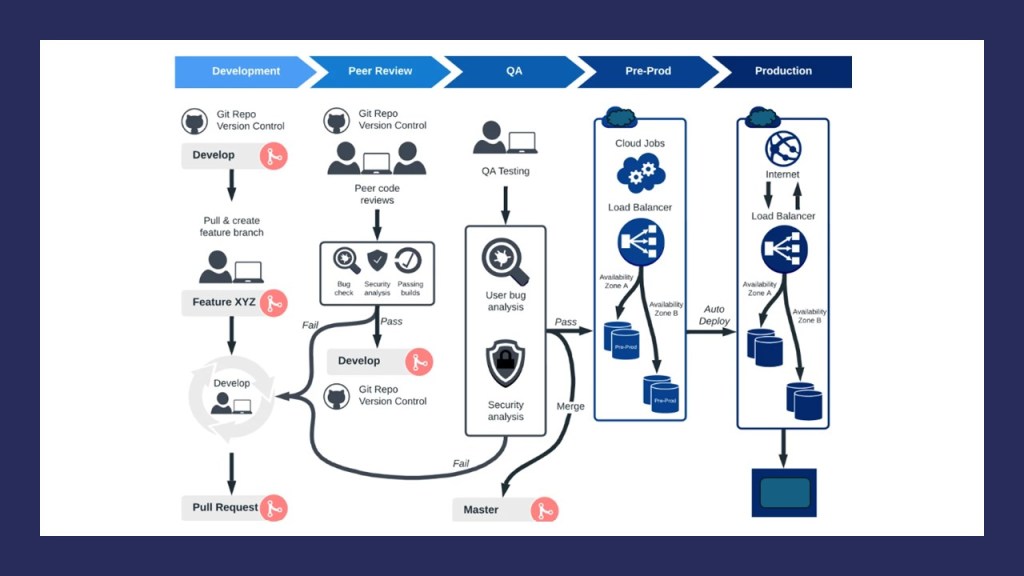
Commencing on a software development journey entails navigating through a maze of processes, from code creation to deployment. To simplify this intricate path, Continuous Integration and Continuous Deployment (CI/CD) pipelines serve as indispensable tools. Let’s delve into a blueprint of a typical CI/CD pipeline, designed to streamline the software development lifecycle. (Imge Credit: Jason’s Blog-Beningo)

  • Code Management: The journey begins with source code management, where all project packages and dependencies find their home. Establishing a structured review mechanism ensures code integrity, with designated reviewers approving changes via pull requests. Building upon this foundation, the code undergoes compilation and unit testing, crucial for early issue detection and ensuring application functionality.
  • Testing Environment: Transitioning to the testing environment, integration tests play a pivotal role in validating API behavior and adherence to business rules. This phase ensures that APIs fulfill expected functionalities, such as order creation and adherence to predefined constraints. Toggle switches facilitate flexible stage control, enabling seamless progression through the deployment pipeline.
  • 1-Box Deployment: Mitigating deployment risks, the 1-box deployment strategy facilitates controlled testing with a fraction of production traffic. This precautionary measure minimizes the impact of potential issues, allowing swift rollback in case of anomalies. Rollback alarms and bake periods further fortify the deployment process, ensuring stability and resilience.
  • Production Environment: Finally, the journey culminates in the production environment, where the full deployment unfolds. Here, the same safeguards and monitoring mechanisms are in place to uphold performance standards and swiftly address deviations. With a systematic approach and rigorous testing at each stage, the CI/CD pipeline paves the way for smoother, faster, and more reliable software development.

Conclusion

In summary, adopting CI/CD transforms software development by promoting teamwork, improving productivity, and providing smooth user interactions. Following best practices and using automation empower teams to manage deployment challenges effectively, leading to successful software launches and ongoing improvements.

Building a Successful Engineering Team: The Power of Essential Skills

As a seasoned leader in the engineering industry, I’ve always prioritized hiring the right talent for my team, ensuring that each engineer not only possesses technical expertise but also embodies essential skills that drive success. Over the years, this approach has paid off, with every member of my team not only excelling in their roles but also staying with both me and the organization for the long haul. The key to this success? Cultivating and nurturing essential skills that go beyond technical know-how, fostering a culture of excellence, collaboration, and innovation.

In identifying the top five essential skills for engineers, I’ve drawn upon my extensive experience leading teams and observing firsthand what sets exceptional engineers apart. These skills have been instrumental in shaping the success of my team and have become the foundation upon which I build my hiring criteria. Each skill has been carefully selected for its proven ability to drive performance, foster teamwork, and enable engineers to thrive in today’s rapidly evolving landscape.

  1. Problem-Solving: At the core of engineering, problem-solving skills are paramount for identifying, analyzing, and resolving complex challenges efficiently. Engineers equipped with strong problem-solving abilities can tackle diverse issues with creativity and resourcefulness, leading to innovative solutions and breakthrough advancements. By prioritizing this skill in hiring, I’ve ensured that my team can navigate obstacles effectively, drive continuous improvement, and contribute significantly to the success of projects and organizations.
  2. Critical Thinking: Critical thinking empowers engineers to evaluate information objectively, make informed decisions, and anticipate potential implications and outcomes. Engineers proficient in critical thinking can assess problems from multiple angles, identify underlying patterns and trends, and devise strategic solutions that drive project success. This skill fosters clarity of thought, sound judgment, and the ability to adapt to evolving circumstances, enabling engineers to thrive in dynamic environments and deliver value-added solutions.
  3. Communication: Effective communication is vital for engineers to convey ideas, share insights, and collaborate with diverse stakeholders effectively. Engineers proficient in communication can articulate technical concepts clearly, tailor messages to different audiences, foster collaboration, and ensure alignment between team members, ultimately driving project success and enhancing organizational effectiveness. By mastering communication skills, engineers can foster collaboration, build strong relationships, and ensure alignment between stakeholders, driving project success and enhancing organizational effectiveness.
  4. Adaptability: In today’s rapidly evolving technological landscape, engineers must navigate change, embrace new technologies, and remain resilient in the face of uncertainty. Those proficient in adaptability can embrace challenges as opportunities for growth, quickly acquire new skills and knowledge, and pivot effectively in response to shifting priorities and requirements. This skill enables engineers to stay ahead of the curve, embrace innovation, and drive continuous improvement, positioning them for long-term success and career advancement.
  5. Collaboration: Collaboration skills are essential for engineers to work effectively in interdisciplinary teams, leverage diverse perspectives, and harness collective expertise to solve complex problems and drive collective success. Engineers proficient in collaboration can build rapport, foster trust, and cultivate a culture of teamwork, enabling seamless coordination and synergy among team members. By fostering collaboration, engineers can leverage complementary skills and insights, drive innovation, and deliver superior outcomes that exceed expectations, ultimately contributing to organizational success and driving positive impact.

By prioritizing these essential skills in hiring and nurturing them within my team, I’ve created a culture of excellence and collaboration that drives success in today’s competitive engineering landscape. These skills have not only helped me build high-performing teams but have also empowered engineers to thrive, innovate, and make a lasting impact in their careers. Cultivating these essential skills enables engineers to position themselves for sustained growth, contribute meaningfully to their organizations, and thrive in an increasingly competitive and dynamic engineering landscape.

My Next Gadget – Apple’s Vision Pro: A Glimpse into the Future of Wearable Innovation

Apple has once again taken a giant leap in the world of technology with its latest innovation, the Vision Pro. This cutting-edge gadget marks Apple’s foray into the world of smart eyewear, blending style, functionality, and innovation seamlessly.

Design and Form Factor: The Vision Pro is a sleek and stylish pair of smart glasses that seamlessly integrates into your daily life. With a minimalist design, lightweight frame, and premium materials, Apple has achieved a perfect balance between aesthetics and comfort. The glasses house a discreet display that augments your reality without compromising on the overall design.

Advanced AR Capabilities: At the core of Vision Pro lies its advanced Augmented Reality (AR) capabilities. Whether you’re navigating city streets, exploring landmarks, or receiving real-time information, the AR features elevate your surroundings. Apple has incorporated state-of-the-art sensors and optics, ensuring a seamless AR experience that blends seamlessly with the physical world.

Immersive Audio Experience: Vision Pro doesn’t just focus on visuals; it redefines the audio experience too. With integrated spatial audio technology, the glasses provide an immersive sound experience tailored to your movements and surroundings. This innovation enhances not just what you see but also what you hear, delivering a truly immersive sensory encounter.

Health and Wellness Integration: True to Apple’s commitment to health and wellness, Vision Pro comes equipped with a range of health-centric features. From monitoring daily activity to providing insights into your overall well-being, these smart glasses seamlessly integrate into the Apple ecosystem, syncing with your iPhone and other Apple devices.

Explore more about Apple’s Vision Pro on Apple’s official page and step into a new era of innovation and connectivity.

Vision Pro Teardown

For the tech enthusiasts who crave a glimpse into the inner workings of the Vision Pro, the recent teardown by iFixit provides an in-depth exploration. The teardown offers a fascinating look at the intricate components that power Apple’s latest innovation. Watch the teardown video to uncover the engineering marvel beneath the sleek exterior.

The Future of Wearable Innovation: Apple’s Vision Pro is not just a gadget; it’s a testament to the future of wearable technology. With its seamless integration of AR, immersive audio, and health features, the Vision Pro sets a new standard for smart eyewear. As technology continues to advance, Apple remains at the forefront, pushing boundaries and reshaping how we interact with the digital world.

Transcending Barriers

Challenges in projects, business, or career growth are a given, but it’s our response to them that defines our trajectory. Looking beyond the immediate obstacle, there lies a realm of opportunity and learning. As Helen Keller wisely stated, “Character cannot be developed in ease and quiet. Only through experience of trial and suffering can the soul be strengthened, ambition inspired, and success achieved.” In the journey of overcoming obstacles, we find profound insights from established authors who have navigated similar paths.

In his book “The Obstacle is the Way,” Ryan Holiday draws inspiration from Stoicism, urging readers to perceive obstacles not as roadblocks but as opportunities for growth. This echoes the sentiment of renowned Indian author Ravi Shankar Etteth, who in “The Brahmin,” explores the resilience of the human spirit in the face of adversity. Like a river winding through diverse landscapes, our careers too encounter obstacles that shape and mold us.

Imagine a river’s journey—a metaphor for one’s career—from its origin in the mountains, meandering through valleys, overcoming obstacles in the form of rocks and rapids. Similarly, our professional journey is marked by twists, turns, and challenges. The river teaches us resilience, adapting its course, sometimes rushing with urgency, and at other times flowing serenely. Like a river persistently seeking the vastness of the ocean, our careers aspire for growth, expansion, and the fulfillment of our professional potential.

As we navigate the currents of challenges, let us draw inspiration from the timeless words of Winston Churchill: “Success is not final, failure is not fatal: It is the courage to continue that counts.” In literature and life, obstacles are not roadblocks but stepping stones, guiding us toward greater achievements. Let us embrace the journey beyond the obstacle, for it is there that we uncover our true strengths and capabilities.

The Path to Unbounded Growth

Every individual has a unique potential waiting to be tapped. Recognizing the keys to unlock this potential is what can set us on the path to unprecedented success. As Vincent Van Gogh aptly put it, “Great things are not done by impulse but by a series of small things brought together.” In the journey of personal growth, renowned authors have shared profound insights on how to unlock one’s true potential.

In the classic self-help book “The 7 Habits of Highly Effective People,” Stephen Covey emphasizes the importance of proactivity, urging individuals to take charge of their growth. Indian author Shiv Khera, in “You Can Win,” echoes similar sentiments, providing practical strategies to overcome obstacles and unlock personal potential. The journey of growth is inherently personal, defined and executed by one person—YOU.

To unlock growth, one must confront the fear of failure, recognizing it not as a roadblock but as a stepping stone. A poignant quote from J.K. Rowling captures this essence: “It is impossible to live without failing at something unless you live so cautiously that you might as well not have lived at all.” Embracing failures and learning from them is integral to unlocking our true potential.

Drawing inspiration from the story of cricket legend Marvan Atapattu, whose journey to becoming a great batsman took six years, teaches us the power of perseverance. Atapattu, by going back to basics repeatedly, overcame his fear of failure and believed in his strengths. Similarly, in our growth journey, recognizing our strengths, likes, and dislikes is crucial. Being vocal and not succumbing to tough situations, as highlighted by Indian author Chetan Bhagat in “Five Point Someone,” propels us toward personal and professional growth.

In the end, growth is not a destination but a continuous journey of self-discovery. By unlocking our unique potential, embracing failure, recognizing strengths, and being vocal, we pave the way for a fulfilling and successful life journey. As Albert Einstein wisely said, “Life is like riding a bicycle. To keep your balance, you must keep moving.”