
Leveraging Salesforce CRM Platform as a Service (PaaS) for Enhanced Business Efficiency

Salesforce CRM Platform as a Service (PaaS) offers a robust and versatile framework for businesses to streamline their customer relationship management processes. This article explores the features, benefits, and implementation strategies of Salesforce CRM PaaS, highlighting its potential to drive business growth and enhance customer satisfaction.

In today’s competitive business landscape, effective customer relationship management (CRM) is essential for sustained success. Salesforce CRM Platform as a Service (PaaS) provides businesses with a powerful toolset to manage customer interactions, improve sales efficiency, and boost overall productivity. This white paper aims to delve into the various aspects of Salesforce CRM PaaS and demonstrate its value proposition for organizations across industries.

Overview of Salesforce CRM PaaS:

Salesforce CRM PaaS is a cloud-based platform that enables businesses to build, customize, and deploy CRM solutions tailored to their unique needs. Key components of the Salesforce CRM PaaS ecosystem include:

  1. Lightning Experience: A modern and intuitive user interface that enhances productivity and streamlines navigation.
  2. Salesforce Einstein: Artificial intelligence capabilities that deliver predictive insights, automate tasks, and drive smarter decision-making.
  3. AppExchange: An extensive marketplace offering a wide range of third-party apps and integrations to extend the functionality of Salesforce CRM.
  4. Salesforce Mobile App: Enables access to CRM data and functionality on-the-go, empowering sales teams to stay productive from anywhere.

Benefits of Salesforce CRM PaaS

Implementing Salesforce CRM PaaS offers numerous benefits for businesses, including

  1. Scalability: Salesforce CRM PaaS is highly scalable, allowing businesses to adapt and grow without the need for significant infrastructure investments.
  2. Customization: The platform offers extensive customization options, enabling businesses to tailor CRM solutions to their specific requirements and workflows.
  3. Integration: Salesforce CRM PaaS seamlessly integrates with other business systems and applications, facilitating data sharing and improving cross-functional collaboration.
  4. Analytics: Advanced analytics and reporting capabilities provide valuable insights into customer behavior, sales performance, and business trends, empowering organizations to make data-driven decisions.
  5. Automation: Salesforce CRM PaaS automates repetitive tasks and processes, freeing up valuable time for sales teams to focus on building relationships and driving revenue.
  6. Security: Built-in security features and compliance certifications ensure the protection of sensitive customer data and regulatory compliance.

Implementation Strategies

Successful implementation of Salesforce CRM PaaS requires careful planning and execution. Key strategies for a successful deployment include

  1. Needs Assessment: Conduct a thorough analysis of business requirements and objectives to determine the scope and customization needs of the CRM solution.
  2. Stakeholder Engagement: Engage key stakeholders, including sales, marketing, and customer service teams, throughout the implementation process to ensure alignment and buy-in.
  3. Training and Adoption: Provide comprehensive training and support to users to facilitate adoption and maximize the benefits of the Salesforce CRM PaaS platform.
  4. Data Migration: Develop a robust data migration strategy to ensure seamless transition of existing CRM data to the Salesforce platform, minimizing disruption and data integrity risks.
  5. Continuous Improvement: Implement a process for ongoing monitoring, feedback collection, and system optimization to continuously enhance the effectiveness of the CRM solution.

Salesforce CRM Platform as a Service (PaaS) offers a powerful and flexible solution for businesses seeking to streamline their CRM processes and drive business growth. By leveraging the features and capabilities of Salesforce CRM PaaS, organizations can enhance customer satisfaction, improve sales efficiency, and gain a competitive edge in today’s dynamic marketplace. With careful planning, execution, and ongoing optimization, Salesforce CRM PaaS can serve as a catalyst for success and innovation across industries.
Cloud Computing Services IaaS, PaaS, & SaaS: Choice for Your Business

Cloud Computing and Service Models

Cloud computing revolutionizes IT infrastructure by delivering computing resources over the internet. Three primary service models—Infrastructure as a Service (IaaS), Platform as a Service (PaaS), and Software as a Service (SaaS)—offer varying degrees of control and management, catering to different business needs.

What is IaaS (Infrastructure as a Service)?

IaaS provides virtualized computing resources, including compute, storage, and networking, over the internet. It offers on-demand scalability, allowing businesses to adjust resources based on workload requirements. Compared to on-premise solutions, IaaS offers benefits such as cost savings (no upfront hardware investments), scalability, and flexibility. Major players in IaaS include Amazon Web Services (AWS), Microsoft Azure, and Google Cloud Platform (GCP).

What is PaaS (Platform as a Service)?

PaaS offers a platform for developers to build, deploy, and manage applications without the complexity of underlying infrastructure. It provides software, hardware, and IoT support, streamlining application development and deployment. Compared to on-premise solutions, PaaS offers advantages such as faster time-to-market, reduced development costs, and scalability. Major players in PaaS include Microsoft Azure, Salesforce CRM Platform, Google Cloud Platform, and IBM Cloud.

What is SaaS (Software as a Service)?

SaaS delivers ready-to-use software applications over the internet, eliminating the need for installation and maintenance. It offers accessibility and scalability, enabling businesses to access applications from anywhere with an internet connection. Compared to on-premise solutions, SaaS offers benefits such as lower total cost of ownership (TCO), automatic updates, and simplified management. Major players in SaaS include Salesforce, Microsoft 365, and Google Workspace.

The Business Choice

Choosing the right cloud computing service model depends on your business requirements, technical expertise, and budget constraints. For businesses seeking full control over infrastructure and applications, IaaS provides flexibility and scalability while offering cost savings compared to on-premise solutions. PaaS is ideal for organizations focusing on application development and deployment, offering faster time-to-market and reduced development costs. SaaS offers convenience, accessibility, and lower TCO, making it suitable for businesses looking for ready-to-use software solutions. Ultimately, evaluating use cases, benefits, and major players can help businesses make informed decisions in adopting cloud computing services.

Monorepo vs. Microrepo: Exploring Software Repository Strategies

Within the dynamic sphere of software development, the choice between a Monorepo and a Microrepo significantly impacts how code is managed, shared, and scaled within an organization.

Monorepo (Monolithic Repository):
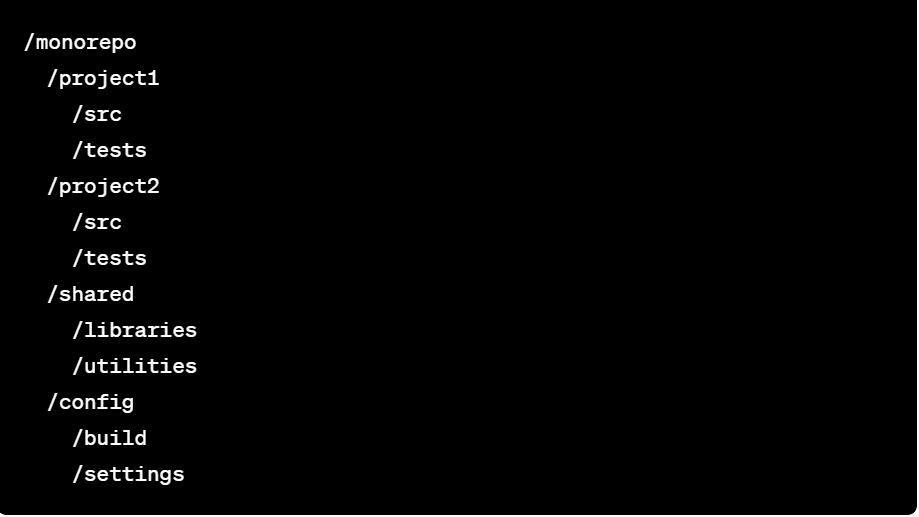
A Monorepo is a single, unified repository that houses code for multiple projects, services, or applications. All code, libraries, and dependencies coexist within the same repository.

Big Organizations Using Monorepo:
Google
Facebook
Twitter

Advantages of MonorepoDisadvantages of Monorepo
Code Sharing: Simplifies code sharing and reuse across projects.Scale Challenges: As the codebase grows, managing a large monorepo can become complex.
Atomic Commits: Enables atomic commits, ensuring consistency in changes across projects.Build Times: Longer build times can be a concern, impacting developer productivity.
Centralized Configuration: Centralized build and configuration settings streamline maintenance.Access Control: Granular access control becomes challenging as more projects share the same repository.
Advantages and Disadvantages of Monorep

Folder Structure (Monorepo):

Factors for Choosing Monorepo:
Code Interdependence: If projects heavily rely on shared code and dependencies.
Consistency: When maintaining consistency across projects is crucial.
Unified Build Process: If a unified build and deployment process is preferred.

Microrepo (Multiple Repositories):
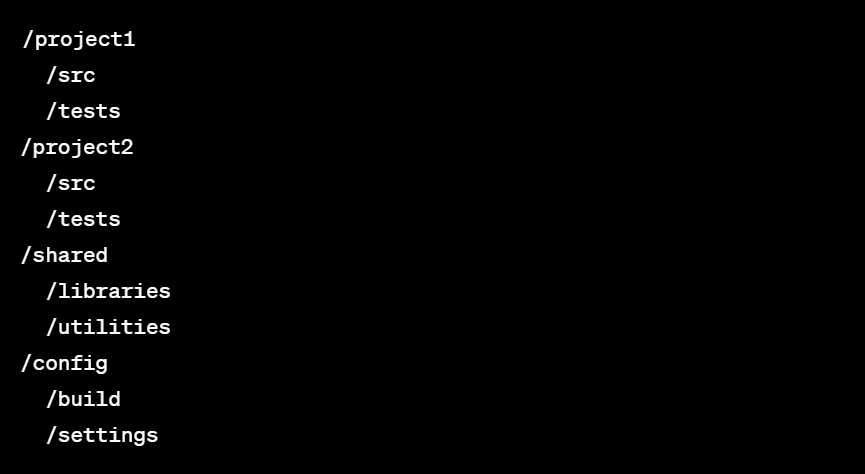
Microrepo involves maintaining separate repositories for individual projects, services, or applications. Each repository is independent and has its own version control.

Big Organizations Using Microrepo:
Netflix
Uber
Airbnb

Advantages of MicrorepoDisadvantages of Microrepo:

Isolation: Isolates projects, minimizing the impact of changes in one project on others.

Code Duplication: Code and dependencies may be duplicated across repositories.
Autonomy: Allows teams to work independently on different services or projects.
Inter-Project Dependencies: Managing dependencies between microrepositories can be challenging.
Simpler CI/CD: Smaller codebases result in faster build and deployment processes.Consistency: Ensuring consistency across projects may require additional effort.
Advantages and Disadvantages of Microrep

Folder Structure (Microrepo):

Factors for Choosing Microrepo:
Independence: When projects can function independently with minimal shared code.
Team Autonomy: If different teams own and manage separate projects.
Scalability: For scalability when dealing with a large number of services.

Choosing the Right Structure:
The Monorepo vs. Microrepo decision hinges on factors like Project/Code Interdependence: Monorepo for high interdependence; Microrepo for independence, Team Structure: Monorepo for collaborative teams; Microrepo for independent teams, Build and Deployment: Monorepo for unified processes; Microrepo for faster, independent CI/CD, and scalability requirements.

Both approaches have their merits, and a hybrid strategy that is there can be benefits to using both, careful consideration is needed to avoid complexity. Microservices can exist in their own repositories, while shared code resides in a monorepo. may offer benefits, provided careful planning and management address potential challenges. Ultimately, the chosen repository strategy should align with the organization’s goals, development practices, and the nature of its projects.

Decoding Success: The Mathematics Behind Every Business

Here is the actual full article Lenny’s Newletter

Key Takeaways:

In the dynamic world of business, success often boils down to a simple equation, and understanding this formula is key to unlocking a venture’s true potential. This article sheds light on the essential business equations that encapsulate the inputs, outputs, and interactions driving various tech business models.

  1. B2B SaaS Equations:
    • Bottom-up B2B SaaS with seat-based pricing.
    • Bottom-up B2B SaaS with usage-based pricing.
    • Top-down (sales-led) B2B SaaS.
  2. B2C/Consumer Equations:
    • B2C with subscription-based pricing (trial or freemium).
    • B2C with ads (free for the user).
  3. Marketplace Equations:
    • B2C marketplaces.
    • B2B marketplaces.
  4. DTC/E-commerce Equation:
    • Direct-to-consumer (DTC) and e-commerce.

How to Make the Most of This Post:

  • Craft your business’s unique equation using inspiration from the examples provided.
  • Engage your team in a discussion about your business growth through the lens of this formula.
  • Identify the highest-leverage levers within your equation and allocate resources strategically.
  • Experiment with new levers to fuel innovation.
  • Consider turning your formula into a comprehensive growth model.

Closing Thoughts: Every business is unique, and while these equations offer foundational insights, they may require adaptation to match the intricacies of your venture. Embrace the challenge, provide feedback on missing elements, and let these equations serve as your guide in navigating the complex landscape of business growth. After all, understanding the mathematics behind your business is the first step towards achieving unprecedented success.