
Docker and virtual machines (VMs) are both integral technologies in application deployment. In the software development lifecycle, deployment involves configuring the application code to be operational for end users.
Definition of Docker
Docker is a containerization platform that allows developers to package applications and their dependencies into lightweight, portable containers. These containers can then be deployed consistently across different environments, from development to production, without the need to worry about differences in underlying infrastructure. Docker provides a standardized way to build, ship, and run applications, enabling greater flexibility, scalability, and efficiency in software development and deployment.
Definition of Virtual Machine (VM)
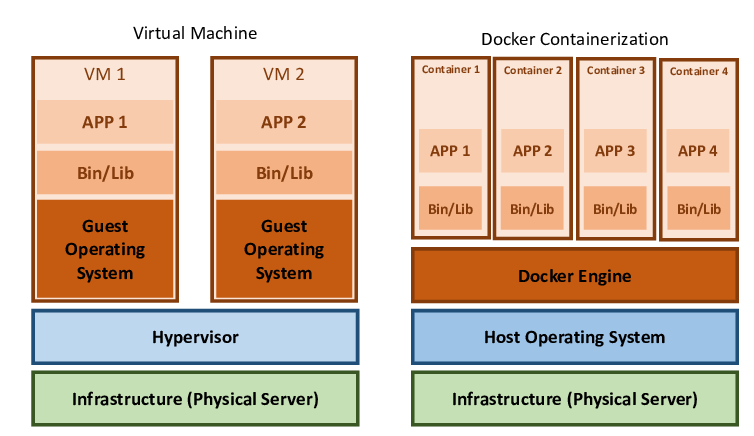
A Virtual Machine (VM) is an emulation of a physical computer that runs an operating system and applications within a virtualized environment. VMs are created using hypervisor software, which partitions a physical server into multiple virtual machines, each with its own virtualized hardware resources, including CPU, memory, storage, and network interfaces. VMs provide a means to run multiple operating systems and applications on a single physical server, enabling greater server utilization and resource isolation.
Benefits of Docker and Virtual Machnes (VM)
Docker offers several benefits, including lightweight and fast containerization, efficient resource utilization, and improved scalability. Containers share the host operating system kernel, resulting in faster startup times and reduced overhead compared to VMs. Docker containers also consume fewer system resources, making them more efficient in terms of CPU, memory, and storage usage. Additionally, Docker enables easy application scaling and orchestration using tools like Docker Swarm and Kubernetes, allowing organizations to deploy and manage large-scale containerized applications with ease.
Virtual Machines provide benefits such as hardware abstraction, isolation, and compatibility across different operating systems. VMs allow organizations to run multiple applications and operating systems on a single physical server, maximizing server utilization and flexibility. VMs also offer strong isolation between applications, ensuring that issues in one VM do not affect others. Furthermore, VMs support a wide range of operating systems, making them suitable for environments with diverse software requirements.
Key Differences between Docker and Virtual Machines
Resource Overhead: Docker containers share the host operating system kernel, resulting in lower resource overhead compared to VMs, which require separate guest operating systems.
Performance: Docker containers offer faster startup times and better performance compared to VMs due to their lightweight nature and shared kernel.
Isolation: While VMs provide strong isolation between applications through virtualization, Docker containers share the host operating system kernel, leading to less isolation.
Portability: Docker containers are more portable than VMs, as they encapsulate both the application and its dependencies, allowing for consistent deployment across different environments.
Management: Docker containers are easier to manage and orchestrate at scale using container orchestration tools like Docker Swarm and Kubernetes, whereas VM management can be more complex.
Similarities between Docker and Virtual Machines
Both Provide Application Isolation: Both Docker containers and VMs provide a level of isolation for applications, ensuring that they do not interfere with each other.
Both Support Multiple Environments: Both Docker and VMs can be deployed across various environments, including development, testing, and production.
Both Enable Flexibility in Deployment: Docker containers and VMs allow for flexible deployment of applications, enabling organizations to adapt to changing business requirements.
When to Use Docker & Virtual Machies
Docker is ideal for microservices-based architectures, cloud-native applications, and containerized workloads where scalability, portability, and efficiency are paramount. It is well-suited for environments requiring rapid deployment, continuous integration/continuous deployment (CI/CD), and DevOps practices.
Virtual Machines are suitable for environments with diverse operating system requirements, legacy applications, and applications requiring strong isolation. VMs are also useful for environments where compatibility with different operating systems is necessary or when running multiple applications on a single physical server.
In conclusion, the choice between Docker containers and Virtual Machines hinges on the specific requirements and objectives of the deployment environment. While Docker offers lightweight and efficient containerization, ideal for modern microservices architectures and cloud-native applications, Virtual Machines provide robust isolation and compatibility across diverse operating systems, making them suitable for legacy applications and environments with varied software requirements. Understanding the key differences and similarities between Docker and VMs is essential for organizations to make informed decisions about their infrastructure and application deployment strategies. By leveraging the strengths of each technology appropriately, businesses can optimize their resource utilization, enhance scalability, and streamline their software development and deployment processes for greater efficiency and agility in today’s dynamic IT landscape.
 pinnaclevocation